
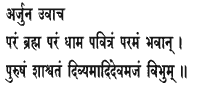
Arjuna said: Thou art the supreme Brahman, the supreme Abode, the supreme Purity, the one permanent, the divine Purusha, the original Godhead, the Unborn, the all-pervading Lord.
The Possibility and Purpose of Avatarhood
Sri Aurobindo
IN SPEAKING of this Yoga in which action and knowledge become one, the Yoga of the sacrifice of works with knowledge, in which works are fulfilled in knowledge, knowledge supports, changes and enlightens works, and both are offered to the Purushottama, the supreme Divinity who becomes manifest within us as Narayana, Lord of all our being and action seated secret in our hearts for ever, who becomes manifest even in the human form as the Avatar, the divine birth taking possession of our humanity, Krishna has declared in passing that this was the ancient and original Yoga which he gave to Vivasvan, the Sun-God, Vivasvan gave it to Manu, the father of men, Manu gave it to Ikshvaku, head of the Solar line, and so it came down from royal sage to royal sage till it was lost in the great lapse of Time and is now renewed for Arjuna, because he is the lover and devotee, friend and comrade of the Avatar. For this, he says, is the highest secret,—thus claiming for it a superiority to all other forms of Yoga, because those others lead to the impersonal Brahman or to a personal Deity, to a liberation in actionless knowledge or a liberation in absorbed beatitude, but this gives the highest secret and the whole secret; it brings us to divine peace and divine works, to divine knowledge, action and ecstasy unified in a perfect freedom; it unites into itself all the Yogic paths as the highest being of the Divine reconciles and makes one in itself all the different and even contrary powers and principles of its manifested being. Therefore this Yoga of the Gita is not, as some contend, only the Karmayoga, one and the lowest, according to them, of the three paths, but a highest Yoga synthetic and integral directing Godward all the powers of our being. Arjuna takes the declaration about the transmission of the Yoga in its most physical sense,—there is another significance in which it can be taken,—and asks how the Sun-God, one of the first-born of beings, ancestor of the Solar dynasty, can have received the Yoga from the man Krishna who is only now born into the world. Krishna does not reply, as we might have expected him to have done, that it was as the Divine who is the source of all knowledge that he gave the Word to the Deva who is his form of knowledge, giver of all inner and outer light,— bhargah. savitur devasya yo no dhiyah. pracoday¯ at; he accepts instead the opportunity which Arjuna gives him of declaring his concealed Godhead, a declaration for which he had prepared when he gave himself as the divine example for the worker who is not bound by his works, but which he has not yet quite explicitly made. He now openly announces himself as the incarnate Godhead, the Avatar. We have had occasion already, when speaking of the divine Teacher, to state briefly the doctrine of Avatarhood as it appears to us in the light of Vedanta, the light in which theGita presents it to us.We must now look a little more closely at this Avatarhood and at the significance of the divine Birth of which it is the outward expression; for that is a link of considerable importance in the integral teaching of the Gita. And we may first translate the words of the Teacher himself in which the nature and purpose of Avatarhood are given summarily and remind ourselves also of other passages or references which bear upon it. “Many are my lives that are past, and thine also, O Arjuna; all of them I know, but thou knowest not, O scourge of the foe. Though I am the unborn, though I am imperishable in my self-existence, though I am the Lord of all existences, yet I stand upon my own Nature and I come into birth by my self-Maya. For whensoever there is the fading of the Dharma and the uprising of unrighteousness, then I loose myself forth into birth. For the deliverance of the good, for the destruction of the evil-doers, for the enthroning of the Right I am born from age to age. He who knoweth thus in its right principles my divine birth and my divine work, when he abandons his body, comes not to rebirth, he comes to Me, O Arjuna. Delivered from liking and fear and wrath, full of me, taking refuge in me, many purified by austerity of knowledge have arrived at my nature of being (madbh¯avam, the divine nature of the Purushottama). As men approach me, so I accept them to my love (bhaj¯ami); men follow in every way my path, O son of Pritha.” But most men, the Gita goes on to say, desiring the fulfilment of their works, sacrifice to the gods, to various forms and personalities of the one Godhead, because the fulfilment (siddhi) that is born of works,—of works without knowledge, —is very swift and easy in the human world; it belongs indeed to that world alone. The other, the divine self-fulfilment in man by the sacrifice with knowledge to the supreme Godhead, is much more difficult; its results belong to a higher plane of existence and they are less easily grasped. Men therefore have to follow the fourfold law of their nature and works and on this plane of mundane action they seek the Godhead through his various qualities. But, says Krishna, though I am the doer of the fourfold works and creator of its fourfold law, yet I must be known also as the non-doer, the imperishable, the immutable Self. “Works affect me not, nor have I desire for the fruit of works;” for God is the impersonal beyond this egoistic personality and this strife of the modes of Nature, and as the Purushottama also, the impersonal Personality, he possesses this supreme freedom even in works. Therefore the doer of divine works even while following the fourfold law has to know and live in that which is beyond, in the impersonal Self and so in the supreme Godhead. “He who thus knows me is not bound by his works. So knowing was work done by the men of old who sought liberation; do therefore, thou also, work of that more ancient kind done by ancient men.” The second portion of these passages which has here been given in substance, explains the nature of divine works, divyam˙ karma, with the principle of which we have had to deal in the last essay; the first, which has been fully translated, explains the way of the divine birth, divyam˙ janma, the Avatarhood. But we have to remark carefully that the upholding of Dharma in the world is not the only object of the descent of the Avatar, that great mystery of the Divine manifest in humanity; for the upholding of the Dharma is not an all-sufficient object in itself, not the supreme possible aim for the manifestation of a Christ, a Krishna, a Buddha, but is only the general condition of a higher aim and a more supreme and divine utility. For there are two aspects of the divine birth; one is a descent, the birth of God in humanity, the Godhead manifesting itself in the human form and nature, the eternal Avatar; the other is an ascent, the birth of man into the Godhead, man rising into the divine nature and consciousness, madbh¯avam ¯agatah. ; it is the being born anew in a second birth of the soul. It is that new birth which Avatarhood and the upholding of the Dharma are intended to serve. This double aspect in the Gita’s doctrine of Avatarhood is apt to be missed by the cursory reader satisfied, as most are, with catching a superficial view of its profound teachings, and it is missed too by the formal commentator petrified in the rigidity of the schools. Yet it is necessary, surely, to the whole meaning of the doctrine. Otherwise the Avatar idea would be only a dogma, a popular superstition, or an imaginative or mystic deification of historical or legendary supermen, not what the Gita makes all its teaching, a deep philosophical and religious truth and an essential part of or step to the supreme mystery of all, rahasyam uttamam. If there were not this rising of man into the Godhead to be helped by the descent of God into humanity, Avatarhood for the sake of the Dharma would be an otiose phenomenon, since mere Right, mere justice or standards of virtue can always be upheld by the divine omnipotence through its ordinary means, by great men or great movements, by the life and work of sages and kings and religious teachers, without any actual incarnation. The Avatar comes as the manifestation of the divine nature in the human nature, the apocalypse of its Christhood, Krishnahood, Buddhahood, in order that the human nature may by moulding its principle, thought, feeling, action, being on the lines of that Christhood, Krishnahood, Buddhahood transfigure itself into the divine. The law, the Dharma which the Avatar establishes is given for that purpose chiefly; the Christ, Krishna, Buddha stands in its centre as the gate, he makes through himself the way men shall follow. That is why each Incarnation holds before men his own example and declares of himself that he is the way and the gate; he declares too the oneness of his humanity with the divine being, declares that the Son of Man and the Father above from whom he has descended are one, that Krishna in the human body, ma¯nus.ı¯m˙ tanum a¯s´ritam, and the supreme Lord and Friend of all creatures are but two revelations of the same divine Purushottama, revealed there in his own being, revealed here in the type of humanity. That the Gita contains as its kernel this second and real object of the Avatarhood, is evident even from this passage by itself rightly considered; but it becomes much clearer if we take it, not by itself,—always the wrong way to deal with the texts of the Gita,—but in its right close connection with other passages and with the whole teaching. We have to remember and take together its doctrine of the one Self in all, of the Godhead seated in the heart of every creature, its teaching about the relations between the Creator and his creation, its strongly emphasised idea of the vibhu¯ ti,—noting too the language in which the Teacher gives his own divine example of selfless works which applies equally to the human Krishna and the divine Lord of the worlds, and giving their due weight to such passages as that in the ninth chapter, “Deluded minds despise me lodged in the human body because they know not my supreme nature of being, Lord of all existences”; and we have to read in the light of these ideas this passage we find before us and its declaration that by the knowledge of his divine birth and divine works men come to the Divine and by becoming full of him and even as he and taking refuge in him they arrive at his nature and status of being, madbh¯avam. For then we shall understand the divine birth and its object, not as an isolated and miraculous phenomenon, but in its proper place in the whole scheme of the world-manifestation; without that we cannot arrive at its divine mystery, but shall either scout it altogether or accept it ignorantly and, it may be, superstitiously or fall into the petty and superficial ideas of the modern mind about it by which it loses all its inner and helpful significance. For to the modern mind Avatarhood is one of the most difficult to accept or to understand of all the ideas that are streaming in from the East upon the rationalised human consciousness. It is apt to take it at the best for a mere figure for some high manifestation of human power, character, genius, great work done for the world or in the world, and at the worst to regard it as a superstition,—to the heathen a foolishness and to the Greeks a stumbling-block. The materialist, necessarily, cannot even look at it, since he does not believe in God; to the rationalist or the Deist it is a folly and a thing of derision; to the thoroughgoing dualist who sees an unbridgeable gulf between the human and the divine nature, it sounds like a blasphemy. The rationalist objects that if God exists, he is extracosmic or supracosmic and does not intervene in the affairs of the world, but allows them to be governed by a fixed machinery of law,—he is, in fact, a sort of far-off constitutional monarch or spiritual King Log, at the best an indifferent inactive Spirit behind the activity of Nature, like some generalised or abstract witness Purusha of the Sankhyas; he is pure Spirit and cannot put on a body, infinite and cannot be finite as the human being is finite, the ever unborn creator and cannot be the creature born into the world,—these things are impossible even to his absolute omnipotence. To these objections the thoroughgoing dualist would add that God is in his person, his role and his nature different and separate from man; the perfect cannot put on human imperfection; the unborn personal God cannot be born as a human personality; the Ruler of the worlds cannot be limited in a nature-bound human action and in a perishable human body. These objections, so formidable at first sight to the reason, seem to have been present to the mind of the Teacher in the Gita when he says that although the Divine is unborn, imperishable in his self-existence, the Lord of all beings, yet he assumes birth by a supreme resort to the action of his Nature and by force of his self-Maya; that he whom the deluded despise because lodged in a human body, is verily in his supreme being the Lord of all; that he is in the action of the divine consciousness the creator of the fourfold Law and the doer of the works of the world and at the same time in the silence of the divine consciousness the impartial witness of the works of his own Nature,—for he is always, beyond both the silence and the action, the supreme Purushottama. And the Gita is able to meet all these oppositions and to reconcile all these contraries because it starts from the Vedantic view of existence, of God and the universe. For in the Vedantic view of things all these apparently formidable objections are null and void from the beginning. The idea of the Avatar is not indeed indispensable to its scheme, but it comes in naturally into it as a perfectly rational and logical conception. For all here is God, is the Spirit or Self-existence, is Brahman, ekamev¯ advit¯ıyam,—there is nothing else, nothing other and different from it and there can be nothing else, can be nothing other and different from it; Nature is and can be nothing else than a power of the divine consciousness; all beings are and can be nothing else than inner and outer, subjective and objective soul-forms and bodily forms of the divine being which exist in or result from the power of its consciousness. Far from the Infinite being unable to take on finiteness, the whole universe is nothing else but that; we can see, look as we may, nothing else at all in the whole wide world we inhabit. Far from the Spirit being incapable of form or disdaining to connect itself with form of matter or mind and to assume a limited nature or a body, all here is nothing but that, the world exists only by that connection, that assumption. Far from the world being a mechanism of law with no soul or spirit intervening in the movement of its forces or the action of its minds and bodies,—only some original indifferent Spirit passively existing somewhere outside or above it,—the whole world and every particle of it is on the contrary nothing but the divine force in action and that divine force determines and governs its every movement, inhabits its every form, possesses here every soul and mind; all is in God and in him moves and has its being, in all he is, acts and displays his being; every creature is the disguised Narayana. Far from the unborn being unable to assume birth, all beings are even in their individuality unborn spirits, eternal without beginning or end, and in their essential existence and their universality all are the one unborn Spirit of whom birth and death are only a phenomenon of the assumption and change of forms. The assumption of imperfection by the perfect is the whole mystic phenomenon of the universe; but the imperfection appears in the form and action of the mind or body assumed, subsists in the phenomenon,—in that which assumes it there is no imperfection, even as in the Sun which illumines all there is no defect of light or of vision, but only in the capacities of the individual organ of vision. Nor does God rule the world from some remote heaven, but by his intimate omnipresence; each finite working of force is an act of infinite Force and not of a limited separate selfexistent energy labouring in its own underived strength; in every finite working of will and knowledge we can discover, supporting it, an act of the infinite all-will and all-knowledge. God’s rule is not an absentee, foreign and external government; he governs all because he exceeds all, but also because he dwells within all movements and is their absolute soul and spirit. Therefore none of the objections opposed by our reason to the possibility of Avatarhood can stand in their principle; for the principle is a vain division made by the intellectual reason which the whole phenomenon and the whole reality of the world are busy every moment contradicting and disproving. But still, apart from the possibility, there is the question of the actual divine working,—whether actually the divine consciousness does appear coming forward from beyond the veil to act at all directly in the phenomenal, the finite, the mental and material, the limited, the imperfect. The finite is indeed nothing but a definition, a face-value of the Infinite’s self-representations to its own variations of consciousness; the real value of each finite phenomenon is an infinite value, is indeed the very Infinite. Each being is infinite in its self-existence, whatever it may be in the action of its phenomenal nature, its temporal selfrepresentation. The man is not, when we look closely, himself alone, a rigidly separate self-existent individual, but humanity in a mind and body of itself; and humanity too is no rigidly separate self-existent species or genus, it is the All-existence, the universal Godhead figuring itself in the type of humanity; there it works out certain possibilities, develops, evolves, as we now say, certain powers of its manifestations. What it evolves, is itself, is the Spirit. For what we mean by Spirit is self-existent being with an infinite power of consciousness and unconditioned delight in its being; it is either that or nothing, or at least nothing which has anything to do with man and the world or with which, therefore, man or the world has anything to do. Matter, body is only a massed motion of force of conscious being employed as a starting-point for the variable relations of consciousness working through its power of sense; nor is Matter anywhere really void of consciousness, for even in the atom, the cell there is, as is now made abundantly clear in spite of itself by modern Science, a power of will, an intelligence at work; but that power is the power of will and intelligence of the Self, Spirit or Godhead within it, it is not the separate, self-derived will or idea of the mechanical cell or atom. This universal will and intelligence, involved, develops its powers from form to form, and on earth at least it is in man that it draws nearest to the full divine and there first becomes, even in the outward intelligence in the form, obscurely conscious of its divinity. But still there too there is a limitation, there is that imperfection of the manifestation which prevents the lower forms from having the self-knowledge of their identity with the Divine. For in each limited being the limitation of the phenomenal action is accompanied by a limitation also of the phenomenal consciousness which defines the nature of the being and makes the inner difference between creature and creature. TheDivine works behind indeed and governs its special manifestation through this outer and imperfect consciousness and will, but is itself secret in the cavern, guh¯ay¯am, as the Veda puts it, or as the Gita expresses it, “In the heart of all existences the Lord abides turning all existences as if mounted on amachine by Maya.” This secret working of the Lord hidden in the heart from the egoistic nature-consciousness through which he works, is God’s universal method with creatures. Why then should we suppose that in any form he comes forward into the frontal, the phenomenal consciousness for a more direct and consciously divine action? Obviously, if at all, then to break the veil between himself and humanity which man limited in his own nature could never lift. The Gita explains the ordinary imperfect action of the creature by its subjection to the mechanism of Prakriti and its limitation by the self-representations of Maya. These two terms are only complementary aspects of one and the same effective force of divine consciousness. Maya is not essentially illusion,— the element or appearance of illusion only enters in by the ignorance of the lower Prakriti, Maya of the three modes of Nature, —it is the divine consciousness in its power of various selfrepresentation of its being, while Prakriti is the effective force of that consciousness which operates to work out each such self-representation according to its own law and fundamental idea, svabh¯ava and svadharma, in its own proper quality and particular force of working, gun. a-karma. “Leaning—pressing down upon my own Nature (Prakriti) I create (loose forth into various being) all this multitude of existences, all helplessly subject to the control of Nature.” Those who know not the Divine lodged in the human body, are ignorant of it because they are grossly subject to this mechanism of Prakriti, helplessly subject to its mental limitations and acquiescent in them, and dwell in an Asuric nature that deludes with desire and bewilders with egoism the will and the intelligence, mohin¯ı ˙ m prakr. tim˙ s´rita¯h. . For the Purushottama within is not readily manifest to any and every being; he conceals himself in a thick cloud of darkness or a bright cloud of light, utterly he envelops and wraps himself in his Yogamaya.1 “All this world,” says the Gita, “because it is bewildered by the three states of being determined by the modes of Nature, fails to recognise me, for this my divine Maya of the modes of Nature is hard to get beyond; those cross beyond it who approach Me; but those who dwell in the Asuric nature of being, have their knowledge reft from them by Maya.” In
other words, there is the inherent consciousness of the divine in all, for in all the Divine dwells; but he dwells there covered by his Maya and the essential self-knowledge of beings is reft from them, turned into the error of egoism by the action ofMaya, the action of the mechanism of Prakriti. Still by drawing back from the mechanism of Nature to her inner and secret Master man can become conscious of the indwelling Divinity. Now it is notable that with a slight but important variation of language the Gita describes in the same way both the action of the Divine in bringing about the ordinary birth of creatures and his action in his birth as the Avatar. “Leaning upon my own Nature, prakr.ti ˙ m sv¯am avas.t. abhya,” it will say later, “I loose forth variously, visr.j ¯ami, this multitude of creatures helplessly subject owing to the control of Prakriti, ava´sa ˙ mprakr. ter va´s ¯ at.” “Standing upon my own Nature,” it says here, “I am born by my self-Maya, prakr.ti ˙ m sv¯am adhis.t. h¯aya . . . ¯atmam¯ayay¯a, I loose forth myself, ¯atm¯ana ˙ m sr. j¯ami.” The action implied in the word avas.t. abhya is a forceful downward pressure by which the object controlled is overcome, oppressed, blocked or limited in its movement or working and becomes helplessly subject to the controlling power, avas´am˙ vas´a¯t; Nature in this action becomes mechanical and its multitude of creatures are held helpless in the mechanism, not lords of their own action. On the contrary the action implied in the word adhis.t. h¯aya is a dwelling in, but also a standing upon and over the Nature, a conscious control and government by the indwelling Godhead, adhis.t. h¯ atr¯ı devat ¯a, in which the Purusha is not helplessly driven by the Prakriti through ignorance, but rather the Prakriti is full of the light and the will of the Purusha. Therefore in the normal birth that which is loosed forth,—created, as we say,—is the multitude of creatures or becomings, bhu¯ tagra¯mam; in the divine birth that which is loosed forth, self-created, is the self-conscious self-existent being, ¯atm¯anam; for the Vedantic distinction between ¯atm¯a and bhu¯ ta¯ni is that which is made in European philosophy between the Being and its becomings. In both cases Maya is the means of the creation or manifestation, but in the divine birth it is by self-Maya, ¯atmam¯ayay¯a, not the involution in the lower Maya of the ignorance, but the conscious action of the self-existent Godhead in its phenomenal self-representation, well aware of its operation and its purpose,—that which the Gita calls elsewhere Yogamaya. In the ordinary birth Yogamaya is used by the Divine to envelop and conceal itself from the lower consciousness, so it becomes for us the means of the ignorance, avidy¯a-m¯ay¯a; but it is by this same Yogamaya that self-knowledge also is made manifest in the return of our consciousness to the Divine, it is the means of the knowledge, vidy¯a-m¯ay¯a; and in the divine birth it so operates—as the knowledge controlling and enlightening the works which are ordinarily done in the Ignorance. The language of the Gita shows therefore that the divine birth is that of the conscious Godhead in our humanity and essentially the opposite of the ordinary birth even though the same means are used, because it is not the birth into the Ignorance, but the birth of the knowledge, not a physical phenomenon, but a soul-birth. It is the Soul’s coming into birth as the self-existent Being controlling consciously its becoming and not lost to selfknowledge in the cloud of the ignorance. It is the Soul born into the body as Lord of Nature, standing above and operating in her freely by its will, not entangled and helplessly driven round and round in the mechanism; for it works in the knowledge and not, as most do, in the ignorance. It is the secret Soul in all coming forward from its governing secrecy behind the veil to possess wholly in a human type, but as the Divine, the birth which ordinarily it possesses only from behind the veil as the Ishwara while the outward consciousness in front of the veil is rather possessed than in possession because there it is a partially conscious being, the Jiva lost to self-knowledge and bound in its works through a phenomenal subjection to Nature. The Avatar2 therefore is a direct manifestation in humanity by Krishna the divine Soul of that divine condition of being to which Arjuna, the human soul, the type of a highest human being, a Vibhuti, is called upon by the Teacher to arise, and to which he can
only arise by climbing out of the ignorance and limitation of his ordinary humanity. It is the manifestation from above of that which we have to develop from below; it is the descent of God into that divine birth of the human being into which we mortal creatures must climb; it is the attracting divine example given by God to man in the very type and form and perfected model of our human existence.
Sri Aurobindo
 About Us | ©1999 - 2009 searchforlight.org
All extracts and quotations from the written works of Sri Aurobindo and the Mother and the Photographs of
the Mother and Sri Aurobindo are copyright Sri Aurobindo Ashram Trust, Pondicherry -605002 India.